
2026/10/23 · 11 views
Choosing between Type A and Type B packaging is the highest-stakes compliance call in radiopharmaceutical transport. Under-pack and you risk enforcement; over-pack and a $200 courier shipment becomes a $20,000 cask project. This article explains the IAEA SSR-6 framework and how A1 (special-form) and A2 (normal-form) activity limits decide whether a shipment qualifies as Type A or must escalate to Type B(U)/B(M). It contrasts test regimes — Type A survives normal transport (0.9 m drop, water spray) while Type B must survive a 9 m drop, 800 °C fire and 15 m water immersion — and separates the two axes buyers confuse: package type (A/B) versus label category (White I / Yellow II / Yellow III, set by surface dose rate). The conclusion: ~95% of patient-dose FDG, Tc-99m, Ga-68, I-131 and Lu-177 shipments stop at Type A Yellow II; Type B is reserved for multi-Ci sealed sources and bulk production returns.
The single most expensive question in radiopharmacy logistics
A cyclotron site ships 40 GBq of F-18 fluoride to a satellite pharmacy 200 km away. A theranostics distributor sends a 74 GBq Lu-177 vial to a hospital in another state. A research lab returns a spent Y-90 source to the supplier. In each case, the shipper must answer the same regulatory question before the first box leaves the building:
Does this shipment go in a Type A package, or do I need a Type B?
Get it wrong and the consequences are asymmetric. Under-pack a high-activity source and you face a DOT/IAEA enforcement action, route rejections, and — worst case — an uncontrolled release in a crash. Over-pack a routine patient dose into a Type B cask and you have just turned a $200 courier job into a $20,000 logistics project that takes three weeks to schedule.
This guide explains the IAEA SSR-6 framework, the A1/A2 activity numbers that decide everything, the Yellow I/II/III labeling rules, and where APEX Type A radiopharmacy shippers fit into the picture.
1. The radioactive package hierarchy (IAEA SSR-6)
The IAEA's Regulations for the Safe Transport of Radioactive Material (SSR-6, mirrored in US 49 CFR 173, EU ADR, ICAO Technical Instructions and IMDG Code) defines a ladder of package types. You climb the ladder as the activity inside the package rises:
Excepted package — very low activity, minimal labeling.
Industrial package (IP-1 / IP-2 / IP-3) — for LSA low-spread material and contaminated objects.
Type A package — limited activity; survives normal transport conditions and minor mishaps.
Type B(U) / Type B(M) package — any activity above Type A; survives severe accident conditions.
Type C package — air-transport grade; survives a high-speed aircraft crash.
For 95% of radiopharmacy shipments — FDG, Tc-99m kits, Ga-68 DOTATATE, Lu-177 therapy doses, I-131 capsules — you stop at Type A. Type B is reserved for high-activity sealed sources, spent fuel and teletherapy heads.
2. Type A packages: the workhorse of nuclear medicine
What Type A actually means
A Type A package is a shielded, containment-tested assembly designed to safely carry radioactive material up to the Type A quantity limit — defined as A1 for special-form material and A2 for normal-form material.
The regulatory logic is risk-based: A1 and A2 are calibrated so that an unprotected person standing 1 meter from the package for 30 minutes receives no more than 50 mSv — a dose that is serious but not life-threatening. That single calibration defines every A1/A2 number in the table.
Special form vs normal form
* Special form (A1): sealed, solid, non-dispersible capsules — like a Co-60 or Ir-192 source pellet. Cannot break open and disperse.
* Normal form (A2): everything else — liquids, powders, gels, solutions. Almost every radiopharmaceutical vial or syringe is normal form, so the A2 limit governs it.
What a Type A must survive
Type A packages are tested under normal transport conditions: water spray, free drop from 0.9 m, penetration drop, compression, and vibration. They are not designed for a truck crash — they are designed for the bumps, drops and rain of ordinary courier handling.
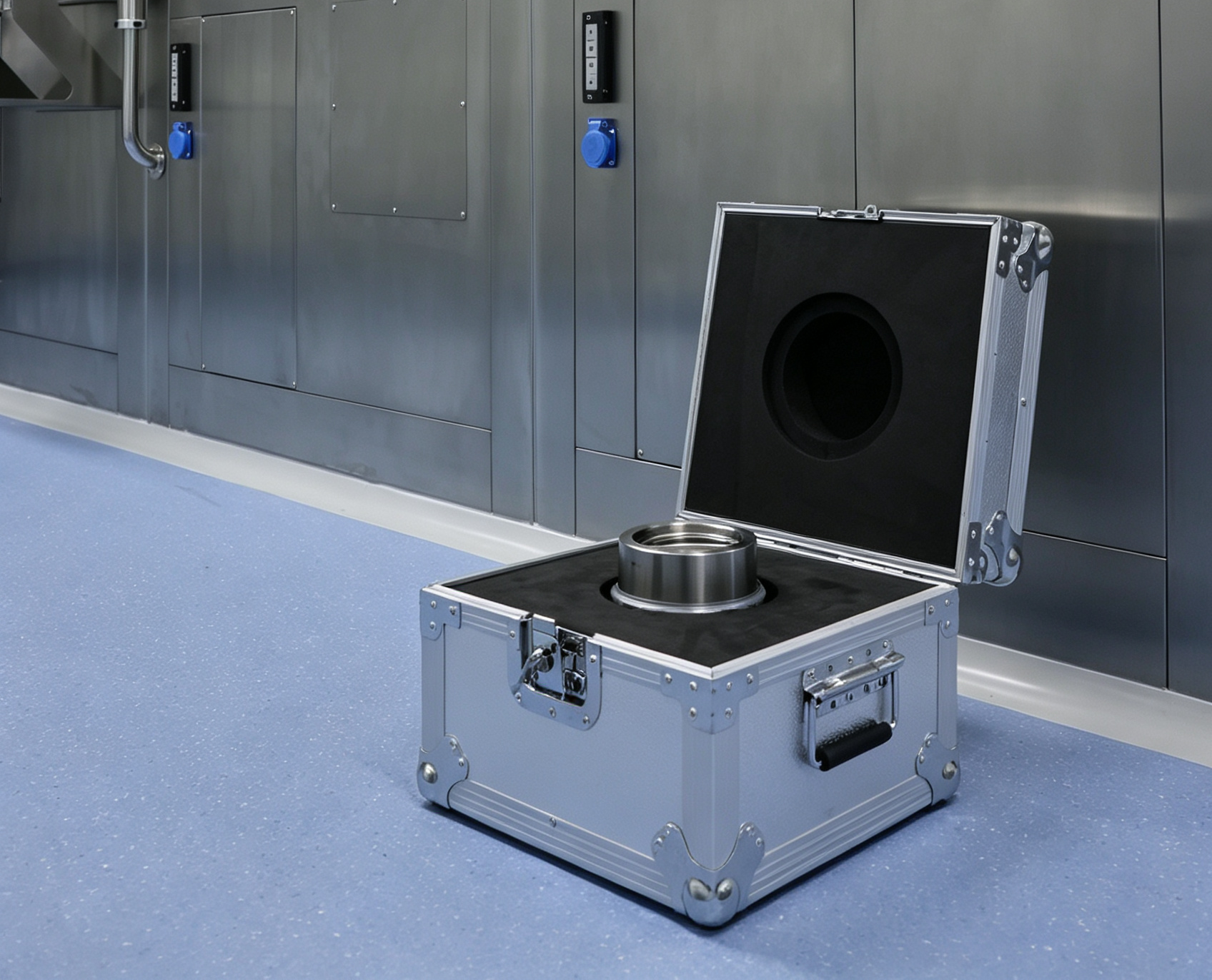
Typical Type A radiopharmacy shipper: a lead or tungsten inner pot (30 mm Pb equivalent for F-18) inside a rigid steel or plywood outer drum, with absorbent, a leak-proof inner bag, and a Yellow II label.
Real-world example
A commercial F-18 unit-dose shipper might be authorized for 2 × 3–5 mL syringes, up to 37 GBq (1,000 mCi) of F-18 at Yellow II category, weighing around 28 kg. That single data point — 37 GBq in a Type A Yellow II — tells you most of what you need: routine PET radiopharmacy logistics never touch Type B.
3. Type B(U) and Type B(M): the accident-grade casks
When the activity exceeds A1/A2 — or when the source is so radioactive that even a small release in an accident is unacceptable — you must use a Type B package.
What Type B must survive
Type B designs are qualified against hypothetical accident conditions in addition to the normal-transport tests:
* 9-meter free drop onto an unyielding surface.
* 1-meter puncture drop onto a steel spike.
* Thermal test: engulfment in an 800 °C fire for 30 minutes.
* Water immersion: 15 m depth for 8 hours (deeper for some designs).
After the full test sequence, the package must:
* Keep leakage below 10⁻⁶ A2 per hour, and
* Keep surface dose rate within 20% of its pre-test value.
B(U) vs B(M)
* Type B(U) — "unilateral": designed and approved by one competent authority (e.g. US NRC, BAM Germany, ONR UK) and accepted in all IAEA member states by reciprocity.
* Type B(M) — "multilateral": has operational restrictions (e.g. periodic venting, special loading limits) and must be approved by every country it transits.
When radiopharmaceuticals actually hit Type B
Almost never at the patient-dose level. You encounter Type B when shipping:
* Multi-Ci sealed brachytherapy and teletherapy sources (Co-60, Cs-137, Ir-192 pellets in bulk).
* Spent high-activity sources returned for recycling.
* Very large batches of F-18 or Mo-99 target material from a production site.
* Thorium-227 / Actinium-225 generator systems at multi-GBq scale.
A 7.4 GBq Lu-177 vial for a patient? Still Type A. A 3,700 GBq Co-60 teletherapy head being decommissioned? Definitely Type B.
4. The labels: White I, Yellow II, Yellow III
Package type (A/B) and package category (White/Yellow) are two different axes. The category is set by the surface dose rate, not the activity:
|
Label category |
Max surface dose rate |
Max dose at 1 m |
Transport Index (TI) |
Typical radiopharmacy case |
|
Radioactive White I |
≤ 0.005 mSv/h (0.5 mrem/h) |
— |
0 |
Decayed Tc-99m waste, low-activity kits |
|
Radioactive Yellow II |
≤ 0.5 mSv/h (50 mrem/h) |
≤ 0.01 mSv/h (1 mrem/h) |
0 – 1 |
Most F-18, FDG, Ga-68, Tc-99m shipments |
|
Radioactive Yellow III |
≤ 2 mSv/h (200 mrem/h) |
≤ 0.1 mSv/h (10 mrem/h) |
1 – 10 |
Fresh high-activity F-18 bulk, I-131 therapy batches |
|
HRCQ placard |
> 2 mSv/h surface or > 3000 × A2 activity |
— |
escorted route |
Virtually never in radiopharmacy |
Transport Index (TI) = dose rate at 1 meter, in mSv/h × 100. It tells the carrier how much distance and shielding to keep from people and film.
5. Quick reference: which package for your radiopharmaceutical?
|
Product |
Typical activity per shipment |
Form |
Package type |
Likely label |
|
Tc-99m eluate / MDP kits |
1–30 GBq |
Liquid vial |
Type A |
White I / Yellow II |
|
F-18 fluoride / FDG unit doses |
0.4–37 GBq |
Syringe / vial |
Type A |
Yellow II |
|
Ga-68 DOTATATE / PSMA |
0.1–2 GBq |
Vial |
Type A |
White I / Yellow II |
|
I-131 capsules (therapy) |
0.1–7.4 GBq |
Capsule / vial |
Type A |
Yellow II |
|
Lu-177 DOTATATE (patient dose) |
7.4–18.5 GBq |
Vial |
Type A |
Yellow II / Yellow III |
|
Y-90 microspheres / therapy vial |
2–5 GBq |
Vial |
Type A (with β-lining) |
Yellow II |
|
Ac-225 / Th-227 generator |
Sub-GBq |
Vial |
Type A (sometimes Type B for bulk) |
Yellow II / III |
|
Mo-99 / F-18 bulk from production |
> A2 threshold |
Vial / target |
Type B(U) |
Yellow III |
These are typical commercial ranges — always confirm against the current A1/A2 table in 49 CFR 173.435 / IAEA SSR-6 Table 2.7.2.2.1 and your package's Certificate of Competent Authority.
6. The five questions that lock in your package choice
What is the radionuclide? → Look up its A2 in the SSR-6 / 49 CFR table.
What activity am I actually shipping? → Below A2? Type A candidate. Above A2? Type B.
Special form or normal form? → Sealed capsule = A1. Liquid/syringe = A2.
What surface dose rate will result? → Decides White I vs Yellow II vs Yellow III, and the Transport Index.
What is the mode of transport? → Road (ADR/RID), sea (IMDG), air (ICAO TI — stricter, Type C for air-crash-grade), or courier hand-carried.
A competent Type A shipper manufacturer should provide, with each container: the UN mark, the Certificate of Compliance, the authorized contents list by radionuclide, and the dose-rate measurement at maximum authorized load.
7. Where APEX fits in the Type A / Type B landscape
Let us be precise about scope. APEX Medical Solutions manufactures Type A radiopharmacy transport and shielding equipment — not Type B casks. Type B designs require multi-decade competent-authority certification (NRC, BAM, ANVS, etc.) and are the domain of specialist cask makers.
What APEX supplies for the radiopharmacy shipping chain:
|
Your shipping need |
APEX product |
Package role |
|
F-18 / FDG unit-dose syringe transport to clinics |
APEX Type A Syringe Shipper (tungsten or lead inner pot, UN-marked outer drum) |
Type A, Yellow II |
|
Bulk F-18 / Ga-68 vial shipment from cyclotron |
APEX Type A Vial Shipping Pot (30–50 mm Pb equivalent) |
Type A, Yellow II / III |
|
I-131 / Lu-177 therapy dose courier box |
APEX Lead-Lined Shielded Transfer Box (10–20 mm Pb, lockable, absorbent liner) |
Type A |
|
O-18 water return to cyclotron |
APEX O-18 Water Shipping Container (lead-shielded, UN-qualified) |
Type A |
|
Intra-hot-lab transport between bench and dose-calibrator room |
APEX Multi-syringe Shielded Carrier (3 / 6 / 12 mm Pb tiers) |
Intra-facility, not for public road |
|
Y-90 / P-32 beta emitters |
APEX β-γ Hybrid Shipper (acrylic inner + lead outer) |
Type A |
If your activity genuinely exceeds A2 and you need Type B(U), APEX will refer you to certified cask partners rather than over-specify a product that cannot legally carry the load.
Frequently Asked Questions
Q1. What is the difference between Type A and Type B packaging for radiopharmaceuticals?
Type A packages carry activity up to A1 (special form) or A2 (normal form) and survive normal transport conditions. Type B packages carry any activity above A1/A2 and must survive severe accident conditions — a 9 m drop, a 1 m puncture drop, an 800 °C fire for 30 minutes, and 8 hours under 15 m of water.
Q2. Do I need Type B for my F-18 FDG shipment?
No. Routine FDG shipments (up to \~37 GBq per shipper) travel in certified Type A packages, almost always Yellow II. Type B is only required for bulk cyclotron production above the F-18 A2 limit, not for patient-dose distribution.
Q3. What does A2 mean in radioactive transport?
A2 is the maximum activity of normal-form (non-sealed) radioactive material permitted in a Type A package. It is calibrated so that 30 minutes of unshielded exposure at 1 meter gives ≤ 50 mSv. Liquid radiopharmaceuticals are normal form, so A2 governs them.
Q4. When does a Type A package become Yellow III instead of Yellow II?
Yellow II allows up to 0.5 mSv/h on the package surface and 0.01 mSv/h at 1 meter (TI ≤ 1). If surface dose exceeds 0.5 mSv/h, or dose at 1 meter exceeds 0.01 mSv/h, you must label Yellow III (up to 2 mSv/h surface, TI ≤ 10).
Q5. Can I hand-carry FDG on a commercial flight?
Under ICAO Technical Instructions, radioactive materials are generally forbidden in passenger cabin baggage unless an airline approval is granted. Most PET clinics ship FDG via approved HAZMAT couriers in Type A Yellow II packages. Confirm with your carrier and the IATA Dangerous Goods Regulations before booking.
Q6. What is a Highway Route Controlled Quantity (HRCQ)?
Any shipment exceeding 3000 × A2 triggers HRCQ rules: escorted transport, special routing, Yellow III placards, and 24/7 carrier monitoring. This almost never applies to patient radiopharmacy.
Q7. Where can I buy certified Type A radiopharmaceutical shipping containers?
APEX Medical Solutions supplies UN-marked Type A syringe shippers, vial pots, O-18 water containers and shielded transfer boxes for F-18, Tc-99m, Ga-68, I-131, Lu-177 and Y-90. Request the authorized-contents sheet and Certificate of Compliance with your quote.
Bottom line
For the vast majority of radiopharmacy logistics — FDG, Tc-99m kits, Ga-68 peptides, Lu-177 and I-131 patient doses — Type A is the correct and sufficient package. Type B is reserved for the multi-Ci sealed-source and spent-fuel world, and confusing the two is either a compliance violation or a budget catastrophe.
The decision reduces to three numbers:
The A2 value of your radionuclide (IAEA SSR-6 / 49 CFR 173.435).
The activity you actually ship.
The surface dose rate, which sets White I / Yellow II / Yellow III.
Get those three numbers on paper, hand them to your shipper manufacturer, and ask for a UN-marked Type A package with a contents-authorization sheet that explicitly lists your radionuclide and activity. That is a compliant shipment.
Next step: Send APEX your radionuclide, activity range, and transport mode (road/air/sea, domestic/international). APEX's regulatory team will match you to the correct Type A shipper, supply the Certificate of Compliance and Yellow II labeling kit, and flag immediately if your load case actually requires a Type B referral.
This article is educational for radiopharmacy managers, medical physicists, HAZMAT couriers and procurement teams. It does not replace a site-specific shipping plan reviewed by your qualified radiation protection officer and the competent authority in your jurisdiction.