
1. Project Background and Customer Challenge
1.1 Project context
The customer procured the shielding package for a downstream nuclear medicine / radiopharmacy project involving unsealed gamma-emitting sources. The equipment was required to fit an existing hot-lab layout rather than a standard catalog dimension, and to be compatible with local cleanability and decontamination requirements.
1.2 Customer requirements and design challenges
Operator protection at the workstation. Localized primary shielding directly in front of the operator during vial handling, dose calibrator use and dose preparation, reducing direct exposure to the torso and head.
Modular barrier for the work zone. A surrounding, reconfigurable barrier (wall / cave segment) built from modular blocks, because the room layout could change as workloads evolved.
Selectable lead equivalence. Two lead-thickness options (40 mm Pb and 50 mm Pb) to match different source energies and activities rather than applying a single, over- or under-specified thickness.
Cleanable, encapsulated surface. Lead surfaces had to be sealed and smooth to prevent lead dust or flaking, support wipe-down cleaning, and avoid cross-contamination between preparations.
Control of radiation streaming through joints. Brick joints had to overlap so that scattered and leakage radiation could not stream through the gaps between blocks.
Ergonomic, shielded viewing. The inclined viewing window had to allow visual monitoring of the source and materials without exposing the eyes and face directly, while preserving a comfortable working posture.
2. Regulatory Framework and Design Basis
2.1 Applicable radiation-protection frameworks
The package was engineered on the internationally recognized principle that shielding should be optimized so that occupational doses are kept As Low As Reasonably Achievable (ALARA), considering economic and social factors. The following frameworks were used as the design basis and terminology reference; the installed system's adequacy for a specific room must finally be confirmed by a qualified medical health physicist / radiation safety officer against the actual workload.
GBZ 120—2020, Requirements for Radiation Protection in Nuclear Medicine (national occupational health standard, China), which sets operational protection requirements for nuclear medicine facilities and their shielding equipment.
HJ 1188—2021, Requirements for Radiation Protection and Safety in Nuclear Medicine (Ministry of Ecology and Environment, effective 2021-11-01), supporting facility-level radiation protection and safety practices.
IAEA Safety Standards Series No. GSR Part 3 (2014), Radiation Protection and Safety of Radiation Sources: International Basic Safety Standards, which establishes the requirements for optimization of protection and for personal protective and shielding equipment in medical use.
ICRP Publication 103 (2007), the fundamental ICRP recommendations underpinning the justification, optimization and dose-limitation system applied to occupational exposure.
2.2 Design principles applied to the hardware
Lead equivalence matched to the workload. Lead thickness (40 / 50 mm) is specified as nominal lead thickness; the final required lead equivalence should be derived from the shielded source spectrum (for example, lower-energy gamma emitters such as Tc-99m near 140 keV, higher-energy emitters such as I-131 near 364 keV, or 511-keV annihilation photons from F-18) and the measured workload.
Overlapping joints against streaming. Dovetail-profiled bricks overlap at their ends, and corner bricks turn the wall through its corners, minimizing straight-through leakage paths between blocks.
Encapsulation and contamination control. The L-block lead core is fully enclosed in a welded stainless-steel casing; lead bricks carry a white baked-enamel coating. Both measures encapsulate the lead, simplify decontamination and prevent surface shedding.
Shielded viewing and ergonomics. The inclined lead-glass window preserves a sight line to the source while the lead core protects the body; the 125-degree viewing angle defined in the drawings supports an upright working posture.
3. Solution Design
3.1 System concept
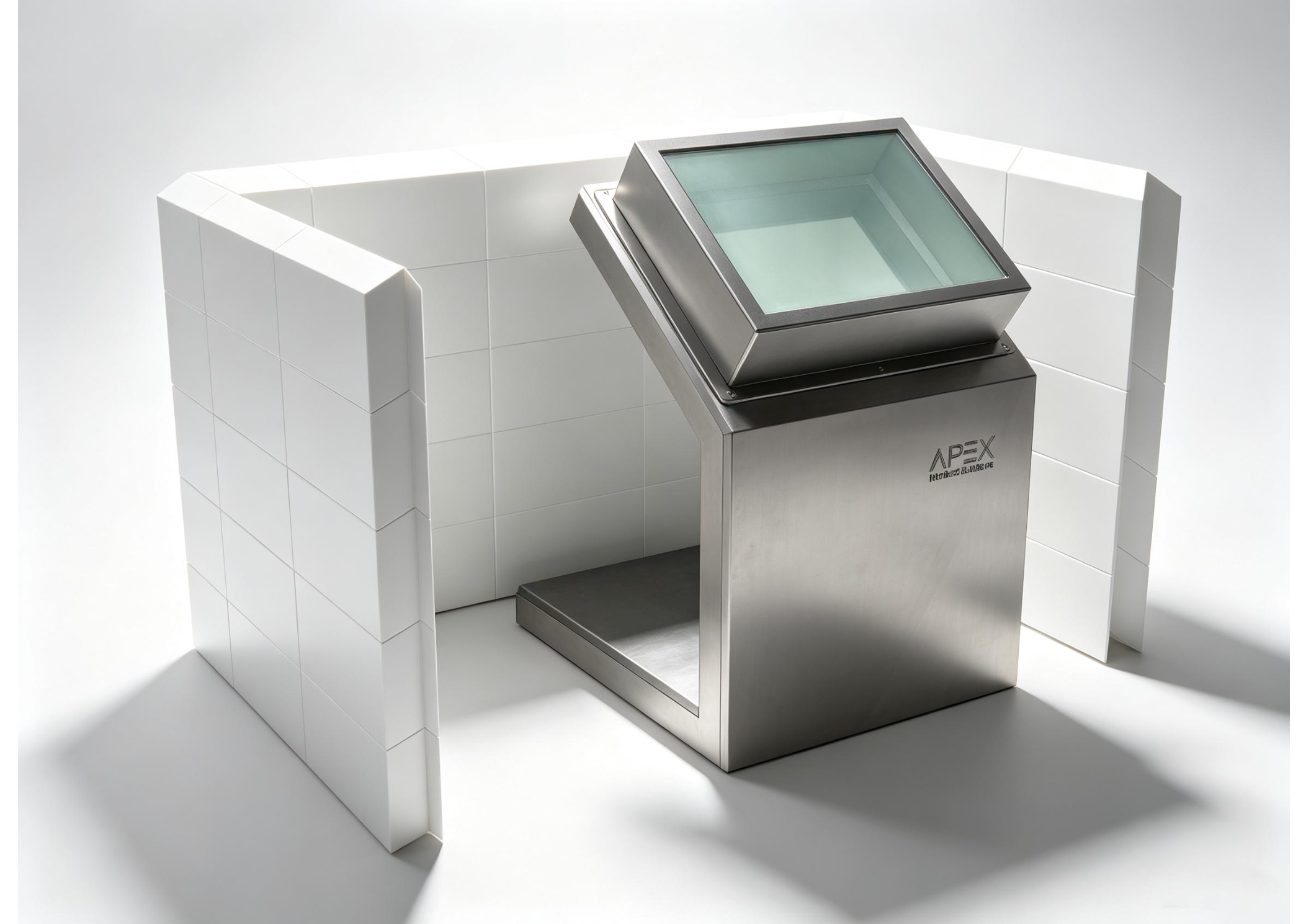
The solution combines a fixed operator station shield with a modular brick barrier. The L-block shield sits at the preparation / dispensing position and protects the person working directly behind it; the lead bricks surround the work zone to attenuate radiation directed toward colleagues, corridors and adjacent rooms. The two elements share the same cleanable, sealed-surface philosophy and can be arranged to follow the actual room footprint.
3.2 L-block shields (40 mm Pb and 50 mm Pb)
Each L-block consists of a lead core enclosed in a welded stainless-steel casing and an inclined viewing window positioned at the workstation. Two versions were quoted to cover different shielding demands: L-block-40mmpb with a 40 mm lead core, and L-block-50mmpb with a 50 mm lead core. Both share the overall envelope of 380 x 420 x 590H (mm).
Section A of each drawing defines an L-shaped section: horizontal base length 420 mm, vertical riser height 340 mm, inclined viewing arm length 320 mm, and a window plane at 125 degrees to the base.
The lead layer thickness is 40 mm on the 40mmpb version and 50 mm on the 50mmpb version on the protected faces; the stainless-steel outer casing provides structural integrity and a wipeable exterior.
The inclined window provides line-of-sight to the vial or instrument below without requiring the operator to look over a vertical barrier, reducing head and neck exposure and improving manipulation accuracy.
The 50 mm option is selected where higher photon energy or higher activity levels make the 40 mm option insufficient; both options use the same footprint to simplify interchange and installation planning.
3.3 Lead brick family
The brick set provides the modular barrier. The standard brick nominal size is 200 (L) x 50 (T) x 100H (mm); all bricks receive a white baked-enamel finish. Three geometries are covered by the drawing:
Rectangular brick (optional). Rectangular (plain) lead brick, 200 x 50 x 100H mm; included in the quotation as an optional SKU for plain wall runs and replacement use.
Dovetail (interlocking) brick. Dovetail lead brick, 200 x 50 x 100H mm, with profiled dovetail ends that engage the neighboring block; quoted quantity 35 pieces. The overlapping profile breaks the straight gap between adjacent bricks and the joint face.
Corner dovetail brick. Corner dovetail lead brick forming the wall turn; quoted quantity 10 pieces, allowing the barrier to turn at 90-degree corners without a direct open seam.
Because the bricks are loose-stacked and interlocked rather than permanently mortared, the wall height and footprint can be reconfigured when the room or workload changes, and damaged or corroded units can be replaced individually.
3.4 Customization workflow followed
Requirement intake: room layout, intended station (dose calibrator / vial preparation / source storage), source mix and expected activity level, and finish requirements.
Shielding concept: selection of L-block lead thickness (40 / 50 mm), brick types and counts, and barrier zoning.
Detailed design: CAD drawings with section views and dimensions.
Commercial confirmation: quotation with quantities, unit prices, delivery and payment terms.
Fabrication: lead core preparation and stainless-steel casing (L-blocks); lead casting, dovetail machining and baked-enamel coating (bricks).
Release and delivery: dimensional and finish inspection, project documentation, and land-freight shipment to the customer-designated location.
4. Application Scenarios and Operational Benefits
4.1 Typical applications
Dispensing and vial-preparation bench in the nuclear medicine hot lab, behind which radiopharmaceutical doses are prepared and checked.
Position adjacent to the dose calibrator during activity measurement, where the source repeatedly passes in and out of the chamber.
Generator elution and vial-handling station, where short manipulation times still require a fixed local barrier.
Modular shielding around an isotope storage bay or waste holding point, built from the interlocked brick set.
4.2 Operational benefits delivered
A two-sided, fixed barrier between source and operator at the workstation, supplementing the time-and-distance controls required by ALARA.
Reconfigurable brick walls that can be extended, shortened or relocated as room use changes, avoiding the cost of permanent masonry shielding.
Sealed, wipe-clean surfaces supporting routine contamination control and periodic decontamination.
A choice of 40 mm and 50 mm lead thicknesses so procurement can match shielding strength to the local source spectrum rather than buy a one-size-fits-all barrier.
Consistent documentation: dedicated drawings per model, which support installation planning, future spare-part orders and regulatory file review.
5. Outcomes and Value Delivered
The project converted a customer-specific shielding need into a defined, drawing-based package: one L-block of each lead thickness for the workstation, plus 35 dovetail bricks and 10 corner dovetail bricks for the modular barrier. The engineering approach balances protection, cleanliness and layout flexibility; the commercial scope was fixed with inclusive tax and freight, a 45-working-day production window and land-freight delivery to the designated site. For the customer, the main value is a coordinated, customizable radiation-protection solution that can be specified order by order, expanded as workload grows, and documented for the facility's radiation-protection file.
Scope of Supply
(i) stainless-steel-encased L-block shields in two lead-equivalence options, 40 mm Pb and 50 mm Pb, each fitted with an inclined lead-glass viewing window; and (ii) a family of interlocking lead bricks, including dovetail bricks and corner dovetail bricks with a white baked-enamel finish.
Outcome
The project converted a customer-specific shielding need into a defined, drawing-based package: one L-block of each lead thickness for the workstation, plus 35 dovetail bricks and 10 corner dovetail bricks for the modular barrier. The engineering approach balances protection, cleanliness and layout flexibility; the commercial scope was fixed with inclusive tax and freight, a 45-working-day production window and land-freight delivery to the designated site. For the customer, the main value is a coordinated, customizable radiation-protection solution that can be specified order by order, expanded as workload grows, and documented for the facility's radiation-protection file.