
1. Scope and Integrated-Solution Approach
This case study shows how APEX converts a facility's workflow, licensed isotope inventory and room zoning into one engineered, interoperable radiation-monitoring package — selected from the APEX Measurement and Monitoring Catalogue rather than assembled as isolated instruments. Every monitoring slot below is matched to a specific APEX AP-series model (or flagged as a service/accessory where the catalogue offers no dedicated instrument), so the configuration reads as a single bill of materials supported by one engineering, calibration, training and after-sales relationship.
1.1 APEX product families referenced in this study
APEX supplies complementary AP-series instrument classes that map directly onto the six-layer monitoring architecture:
Fixed / networked — AP1100C central host, AP1100Med-G/-P and AP1100Med-G Pro/-P Pro area monitors, and the integrated monitoring platform software.
Portable survey — AP3100AB-15 multifunctional meter, AP3100G-P scintillation survey meter, AP3100G-X low-energy/pulsed γ rate meter, AP3200M / AP4005 portable neutron survey meters.
Contamination — AP170 surface contamination monitor, AP4000 / AP4000-T hand-foot personnel frisker.
Personal dosimetry — AP3800G-G / AP3800G-C active personal dosimeter.
Metrology — AP4300-R radioactivity (dose) calibrator, AP4200-HPGe high-purity germanium γ spectrometer.
1.2 The common six-layer monitoring framework
Table 1. Six functional layers and the APEX catalogue models that realise them.
|
Layer |
Purpose |
APEX function & catalog model |
Selection basis |
|
L1 Fixed area / environmental |
Continuous gamma (and neutron where required) dose-rate monitoring with alarm; networked to a central station |
AP1100Med-G / -P fixed X,γ monitors (-G Pro / -P Pro premium concealed-wiring versions) as field detectors, aggregated by the AP1100C multi-probe network host |
Every controlled room, cell, waste store and boundary point |
|
L2 Contamination control |
Removable/fixed surface and personnel (hand-foot) contamination screening before exit |
AP170 handheld surface contamination monitor; AP4000 / AP4000-T hand-foot personnel frisker |
Exit station, hot workbench, hot-cell and therapy-room exit |
|
L3 Portable survey |
Routine room surveys, spill response, source location and leak testing |
AP3100AB-15 multifunctional α/β/X/γ meter (end-window GM); AP3100G-P scintillation γ survey meter; AP3100G-X low-energy/pulsed γ rate meter |
At least one per active department plus spare; task-specific probes |
|
L4 Personal dosimetry |
Measure and alarm individual worker exposure and extremity dose |
AP3800G-G / AP3800G-C active electronic personal dosimeter with tri-mode alarm; passive whole-body and ring service (external accredited provider) |
One EPD/badge per worker; rings for hands-on tasks |
|
L5 Metrology & QC |
Measure activity, verify QC / radiochemical purity |
AP4300-R re-entrant ion-chamber radioactivity (dose) calibrator; AP4200-HPGe γ spectrometer for radionuclide ID and nuclear-purity assay |
Mandatory wherever doses are dispensed or QC is required |
|
L6 Data, records & QA |
Alarm annunciation, data archive, trend analysis and compliance records |
AP1100C/D central monitoring host with integrated platform software (real-time display, data query, alarm management, user/device management) |
Scaled from a small logging panel to a facility network |
2. Department Profile and Representative Clinical Workflows
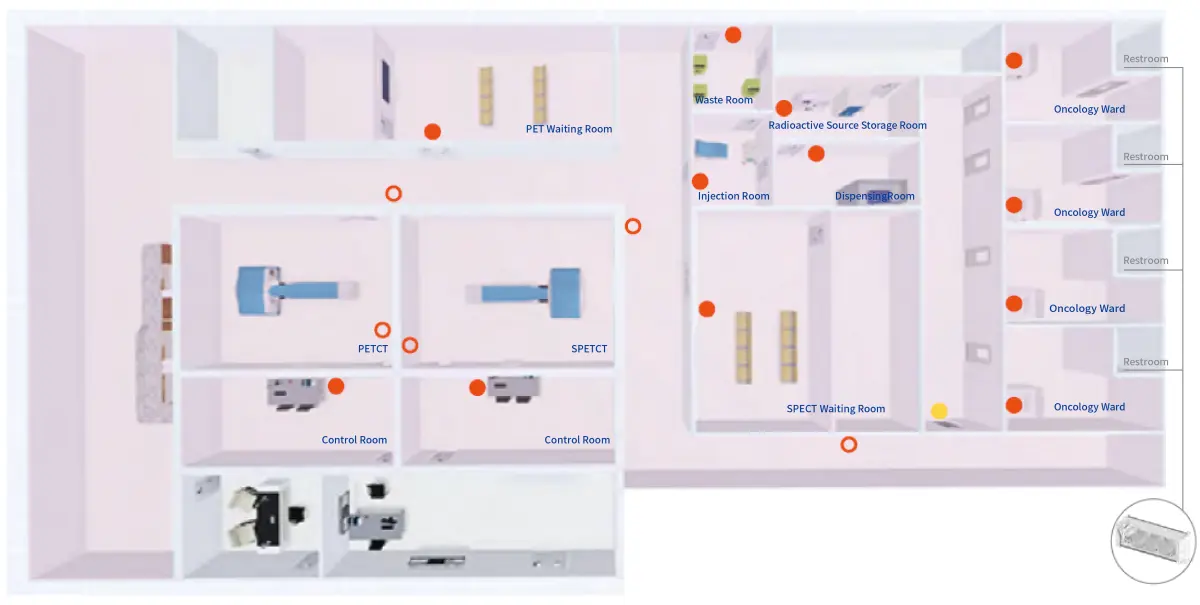
A hospital nuclear-medicine department concentrates radioactive material in a smaller footprint than a production plant: a hot lab / radiopharmacy for receipt, dispensing and compounding; tracer injection and administration rooms; SPECT and PET/CT imaging suites; I-131 therapy capsule preparation and, where offered, isolated therapy wards; patient waiting and post-administration release areas; hot-waste storage; and a staff dosimetry and QC point. Common clinical isotopes may include Tc-99m, F-18/FDG, Ga-68 and I-131, depending on the hospital licence; cyclotron production is usually off-site and material arrives as delivered doses or generators. The monitoring programme protects technologists, radiopharmacists, nurses and admitted patients, controls contamination, and supports clinical metrology and medical-licence inspection.
3. Clinical and Regulatory Drivers
Per-dose activity measured and recorded before administration (AP4300-R programme: daily constancy and periodic accuracy checks).
Worker dose control during repeated syringe manipulation, where extremity (finger) dose often exceeds whole-body dose and justifies ring dosimetry.
Surface & hand contamination control in the hot lab, injection rooms and therapy areas, with wipe/frisk surveys after spills and between procedures.
Iodine-131 intake & airborne control in capsule handling and therapy settings; thyroid bioassay and room/air monitoring where the licence requires.
Dose-rate awareness for high-activity PET work; patient-room and release surveys; waste decay and record keeping.
Calibrated, traceable instrumentation — survey meters calibrated before first use, annually and after relevant repair; metrology records maintained for the radiation-safety committee.
4. Hazard-by-Zone Monitoring Matrix
Table 2. Clinical nuclear-medicine zones, monitored quantity and the APEX model assigned to each zone.
|
Zone |
Principal hazard |
Monitored quantity |
APEX model(s) |
Layer |
|
H1 Hot lab / dispensing |
External γ, hand & bench contamination |
Local dose rate, hand/bench contamination, dispensed activity |
AP4300-R · AP1100Med-G · AP170 |
L1,L2,L5 |
|
H2 Injection / administration |
Staff extremity dose, hand & surface contamination |
Worker extremity/whole-body dose, room surface contamination |
AP3800G-G/C · AP170 |
L2,L4 |
|
H3 SPECT / gamma-camera suite |
Residual room dose, patient-related contamination |
Room ambient trend, post-procedure surface checks |
AP3100G-P · AP1100Med-G (optional) |
L1,L3 |
|
H4 PET/CT suite |
Elevated dose rate in uptake phase, short turnaround |
Local/room dose rate, real-time worker alarm, release surveys |
AP1100Med-G/-P · AP3800G · AP3100G-X |
L1,L3,L4 |
|
H5 I-131 therapy / ward |
Airborne iodine, internal intake, room contamination & waste |
Air activity, staff thyroid count, room dose & contamination |
AP170 · AP3800G · (thyroid/CAM on request) |
L2,L4,L5 |
|
H6 Waiting / release area |
Patient-boundary dose, visitor exposure awareness |
Periodic ambient dose survey, release-condition check |
AP3100G-P |
L3 |
|
H7 Hot waste / isotope store |
Stored γ, contamination on containers |
Storage dose rate, item surface survey |
AP1100Med-G · AP3100AB-15 |
L1,L3 |
|
H8 Staff dosimetry station |
Cumulative worker-dose management |
Personal dose records, EPD download |
AP3800G · AP1100C |
L4,L6 |
|
H9 Public corridor / boundary |
Background & boundary dose assurance |
Periodic boundary survey, fixed alarm indication |
AP1100Med-G · AP3100G-P |
L1,L3 |
5. APEX Integrated Configuration by Six Layers
Table 3. Clinical nuclear-medicine package, deliberately proportioned to clinical throughput rather than production volumes.
|
Layer |
What it measures and why |
APEX model(s) |
Quantity basis |
|
L1 Fixed area |
Continuous awareness where syringes are prepared; trend data for the radiation-safety officer |
AP1100Med-G (energy-compensated GM) in hot lab and high-activity PET/therapy room; boundary survey by portable meter |
Hot lab plus one high-activity room; expandable to other suites |
|
L2 Contamination |
Detect removable contamination on hands, gloves, benches and patients' belongings; verify room cleanliness |
AP170 handheld hand/surface monitor; optional AP4000-T hand-foot unit at exit; wipe support |
One hot-lab unit; optional exit station |
|
L3 Portable survey |
Room and boundary surveys, spill response, package-receipt checks and sealed-source leak tests |
AP3100AB-15 (GM β/γ); AP3100G-P / AP3100G-X low-level & pulsed source locator; backup unit |
≥ one survey meter per active department plus backup |
|
L4 Personal dosimetry |
Cumulative whole-body and hand dose; real-time alert on PET shifts; intake screening for I-131 staff |
AP3800G-G / AP3800G-C EPD for high-dose PET shifts; passive badge + ring service (external); thyroid monitoring (on request) |
One badge per staff; rings for frequent handlers; EPD on justified tasks |
|
L5 Metrology & QC |
Accurate per-dose activity and QC; low-level sample counting |
AP4300-R dose calibrator with constancy check source; AP4200-HPGe for radionuclide ID/purity |
One dose calibrator per dispensing point |
|
L6 Data & QA |
Auditable medical-licence file: QC, survey, dosimetry and training records |
AP1100C / AP1100C-D compact logging panel with platform software; calibration/QC schedule; technologist SOPs |
Scaled to department size; one responsible programme file |
6. Zone-Level Configuration Rationale
H1 Hot lab — AP4300-R as the mandatory metrology anchor; AP1100Med-G fixed monitor near the dispensing shield; AP170 handheld contamination check after preparation; rings for dispensing staff.
H2 Injection rooms — AP3800G EPD and passive/ring badges capture extremity and whole-body dose; AP170 frisk checks after glove removal; bench survey between patients when contamination is suspected.
H3 SPECT suites — routine AP3100G-P survey between studies; fixed AP1100Med-G optional by workload; records support room release for non-radioactive use.
H4 PET/CT — AP3800G personal dosimeter during high-activity preparations; AP1100Med fixed/portable dose-rate awareness; AP3100G-X for the short-lived F-18 field; patient-release and room surveys timed around the short half-life.
H5 I-131 therapy — thyroid monitoring for exposed staff (available on request); AP170 room contamination survey on discharge; iodine-air monitoring and therapy-ward waste controls where required by the licence.
H6–H9 Waiting, waste, dosimetry & boundary — AP3100G-P/AB-15 portable surveys, AP1100Med-G waste-store monitoring and AP1100C badge records maintain the supervised/controlled separation.
7. Clinical Quality Control and Records
AP4300-R dose calibrator: daily constancy check at the start of each working day; accuracy on installation and at intervals set by the medical licence; geometry and linearity checks documented.
Per-dose activity measured and recorded before administration; survey instruments (AP3100 series, AP170) calibrated before first use, annually and after relevant repair; sealed-source leak tests on schedule.
Dosimetry cycle and ring assignment maintained for all radiation workers; thyroid bioassay for iodine-exposed staff; contamination wipe and spill records retained for the radiation-safety committee.
Operator training covering instrument use, alarm response, contamination control and emergency procedures; a single current AP1100C-held SOP set avoids inconsistent practice across shifts.
8. Indicative Clinical Package Tiers
Table 4. Tiered clinical scope sized to common service lines; quantities finalised after room and patient-flow survey.
|
Tier |
Representative scope (APEX models) |
Quantity logic |
|
Mandatory clinical minimum |
AP4300-R dose calibrator with QC source; AP3100AB-15 GM survey meter; AP170 contamination/frisk monitor; AP3800G + passive badge & ring service; AP1100C records & calibration programme |
Required for routine diagnostic nuclear medicine and medical-licence inspection |
|
Recommended service expansion |
AP1100Med-G fixed monitor in hot lab; AP3800G-C EPD for PET shifts; AP4200-HPGe for sample QC; AP3100G-P low-level locator; backup survey meter |
Added with PET, thyroid therapy or higher throughput |
|
Optional specialty items |
AP4000-T hand-foot exit frisker; under-apron badge programme; thyroid/neck monitor and iodine-air CAM (available on request); spare probes & service contract |
Selected by licence conditions and hospital policy |
9. APEX Model-Mapping Worksheet
Slots used in the clinical configuration are resolved against the APEX Measurement and Monitoring Catalogue below. Items flagged as service/accessory or available-on-request have no dedicated catalogue instrument.
Table 5. Functional slots resolved to APEX catalogue models (hospital use).
|
Slot |
Functional family |
APEX catalogue model |
Status |
|
M1 |
Fixed gamma area monitor (networked) |
AP1100Med-G / -G Pro (energy-compensated GM) or AP1100Med-P / -P Pro (plastic scintillator, high range); hosted by AP1100C |
In catalogue |
|
M3 |
Personnel frisker / hand-foot monitor |
AP4000 (4 hand + 2 foot paddles) or AP4000-T |
In catalogue |
|
M4 |
Surface / hand contamination monitor (handheld) |
AP170 (α/β, optional γ) |
In catalogue |
|
M5 |
GM β-γ survey meter |
AP3100AB-15 multifunctional end-window GM meter |
In catalogue |
|
M6 |
Scintillation γ survey / source locator |
AP3100G-P; low-energy / pulsed option AP3100G-X |
In catalogue |
|
M7 |
Active electronic personal dosimeter (EPD) |
AP3800G-G (GM) / AP3800G-C (CsI) |
In catalogue |
|
M10 |
Dose / activity calibrator |
AP4300-R deep-well ionization chamber |
In catalogue |
|
M16 |
Central RMS software / data acquisition |
AP1100C / AP1100C-D host + monitoring platform software |
In catalogue |
|
M15 |
Neutron area / survey monitor |
AP4005 (³He) or AP3200M portable; fixed neutron channel via AP1100C |
In catalogue (portable) |
|
M2 |
Environmental / perimeter outdoor γ probe |
AP1100Med-G deployed outdoors on the AP1100C network (weather-rated enclosure per site) |
Configured — no dedicated outdoor SKU |
|
M11 |
Well counter / sample & wipe counting |
No dedicated catalogue item; γ QC served by AP4200-HPGe |
Available on request |
|
M12 |
Thyroid / neck uptake monitor |
Not in the current monitoring catalogue |
Available on request |
|
M13 |
Continuous air monitor (particulate + iodine) |
Not in the current monitoring catalogue |
Available on request |
|
M14 |
Gaseous / stack effluent monitor |
Not in the current monitoring catalogue |
Available on request |
|
M8 |
Passive whole-body dosimetry |
Accredited external service (no APEX instrument) |
Service / accessory |
|
M9 |
Extremity / ring dosimeter |
Accredited external service (no APEX instrument) |
Service / accessory |
|
M17 |
QC check sources & leak-test kit |
Accessories / long-lived sealed check sources |
Service / accessory |
10. Regulatory Basis and Complementary Shielding / PPE
Programme logic aligns with IAEA workplace-monitoring guidance and the ALARA framework; U.S. NRC 10 CFR Part 20 (occupational monitoring) and Part 35 (medical use — §35.50 dose-calibrator checks, §35.61 survey-instrument calibration, §35.63 activity measurement before administration); and, where applicable, GBZ 120—2020 (radiation-protection requirements for nuclear medicine). Precise thresholds, action levels and frequencies are governed by the operating licence.
Monitoring is paired with verified APEX shielding and PPE — lead/tungsten vial shields, syringe shields and injection workstation, dose-calibrator dipper accessories, radioactive-waste containers, and lead apron, cap, collar, glasses and gloves — which reduce dose (ALARA) alongside, but never in place of, the dosimetry above.
Scope of Supply
The same six-layer APEX solution configured to clinical throughput (rather than production scale) across 9 zones — hot lab/radiopharmacy, injection room, SPECT, PET/CT, I-131 therapy and ward, patient waiting and release, hot-waste storage, dose station and public boundary — plus lead/tungsten shielding and PPE.
Outcome
Anchored on the AP4300-R dose calibrator as the mandatory per-dose measurement core, with AP3800G and finger-ring dosimeters controlling extremity dose and AP170/AP1100C closing the contamination-and-record loop, delivering a traceable, auditable set of records that satisfies medical licence and ALARA requirements as a department-level turnkey package.